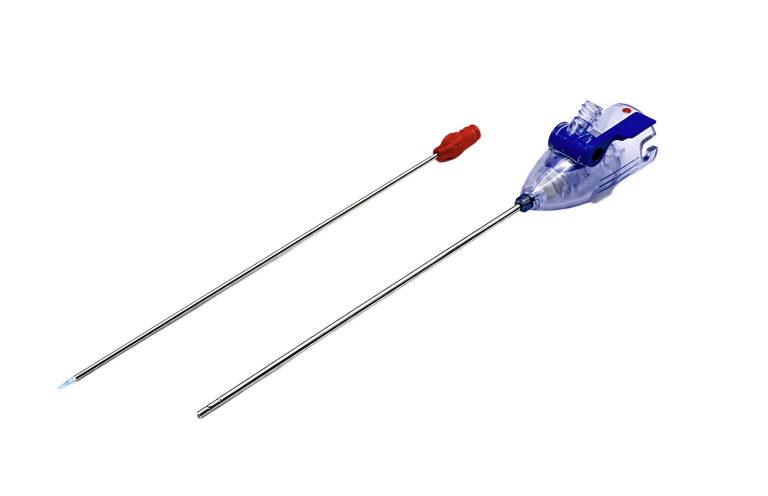
Revolutionizing Abdominal Entry and Mini Laparoscopy
VereSee™ is the first 2 mm mini laparoscope designed to provide direct visualization during abdominal entry, with the ability to continue visualization beyond entry when appropriate.
Unlike traditional optical trocars, which require larger incisions, VereSee™ enables exceptional visualized access with a significantly smaller diameter—supporting a less invasive approach from the start.
Key Features
Real-Time Visualization
Surgeons see exactly where they are entering, ensuring greater accuracy and confidence during the procedure.
Practical Economic Model
The system pairs single-use entry components with reusable visualization technology
2mm Entry
Minimal tissue trauma due to its small size – compared to traditional 5-12mm trocars.
Compact & Easy to Integrate
A camera control unit with HDMI output integrates seamlessly into existing surgical setups.
Post-Entry Inspection
Assess the abdominal cavity immediately after access without additional equipment.
Dual Functionality
VisualEntry System with Mini Laparoscope
Key Features
Real-Time Visualization
Surgeons see exactly where they are entering, ensuring greater accuracy and confidence during the procedure.
2.5 mm Entry
Minimal tissue trauma due to its small size – compared to traditional 5-12mm trocars.
Practical Economic Model
The system pairs single-use entry components with reusable visualization technology
Compact & Easy to Integrate
A camera control unit with HDMI output integrates seamlessly into existing surgical setups.
Dual Functionality
VisualEntry™ System with Mini Laparoscope
Post-Entry Inspection
Assess the abdominal cavity immediately after access without additional equipment.
VereSee™ is a novel 2 mm mini laparoscope that delivers real-time, high-
definition visualization during the critical first step of laparoscopic
surgery, with the ability to provide visualization beyond entry when
appropriate.
Similar in form and handling to the widely used Veress needle, VereSee™ goes further with an integrated high-resolution camera providing excellent direct visual confirmation during peritoneal entry.
While optical trocars have provided visual entry for over two decades, they require significantly larger incisions with diameters ranging from 5mm to 15mm. VereSee™ offers exceptional visualized access in a truly miniaturized format, enhancing precision and control while preserving the simplicity and workflow surgeons expect.
UNMET MARKET NEED
More than 15 million laparoscopic procedures are performed each year, globally1
Yet the initial step of entry remains largely unchanged. Limitations associated with conventional laparoscopic approach include 2:
UNMET MARKET NEED
More than 15 million laparoscopic procedures are performed each year, globally1
Yet the initial step of entry remains largely unchanged. Limitations associated with conventional laparoscopic approach include:
Usually blind entry into the peritoneal cavity2
In fact, about 50% of all laparoscopic complications, [especially 50–83% of serious vascular complications, 41–50% of intestinal complications, and 36% of urological injuries], occur during the initial set up: creation of the pneumoperitoneum and trocar insertion.3
Current methods often rely on blind techniques or large trocars, which can lead to complications
All data sources referenced on this page are listed on our Sourcespage.
VereSee™ addresses this gap, transforming how surgeons approach the crucial step of abdominal access.
Usually blind entry into the peritoneal cavity
Current methods often rely on blind techniques or large trocars, which can lead to complications
In fact, about 50% of all laparoscopic complications, [especially 50–83% of serious vascular complications, 41–50% of intestinal complications, and 36% of urological injuries], occur during the initial set up: creation of the pneumoperitoneum and trocar insertion.3
VereSeeTM addresses this gap, transforming how surgeons approach the crucial step of abdominal access.
All data sources references on this page are listed on our sources page
VereSee™ features a next-generation optical system engineered to deliver real-time visualization during abdominal entry and select mini laparoscopic applications.
Optical Penetrating Tip
Designed for safe, direct visualization during initial access. The lens assembly is embed ded at the tip, enabling clear, forward-facing views as the device enters and passes through tissue planes.
High Resolution Imaging
A miniature yet powerful imaging chip captures high-resolution visuals with exceptional detail, ensuring surgeons maintain situational awareness during critical moments of entry.
HD LED Illumination
Delivers brilliant, shadow-free lighting through integrated fiber optics and LED to illuminate deep anatomical spaces with clarity.
HDMI Output
Provides real-time, high-definition video directly to surgical displays, allowing seamless integration into existing OR visualization systems without requiring proprietary hardware.
Visualization, Reinvented: Watch VereSee Now
for
SURGEONS, PATIENTS, PROGRESS
VereSee™ empowers surgeons with the precision, control, and confidence they deserve—bringing direct visualization to Veress needle access in a compact, intuitive device.